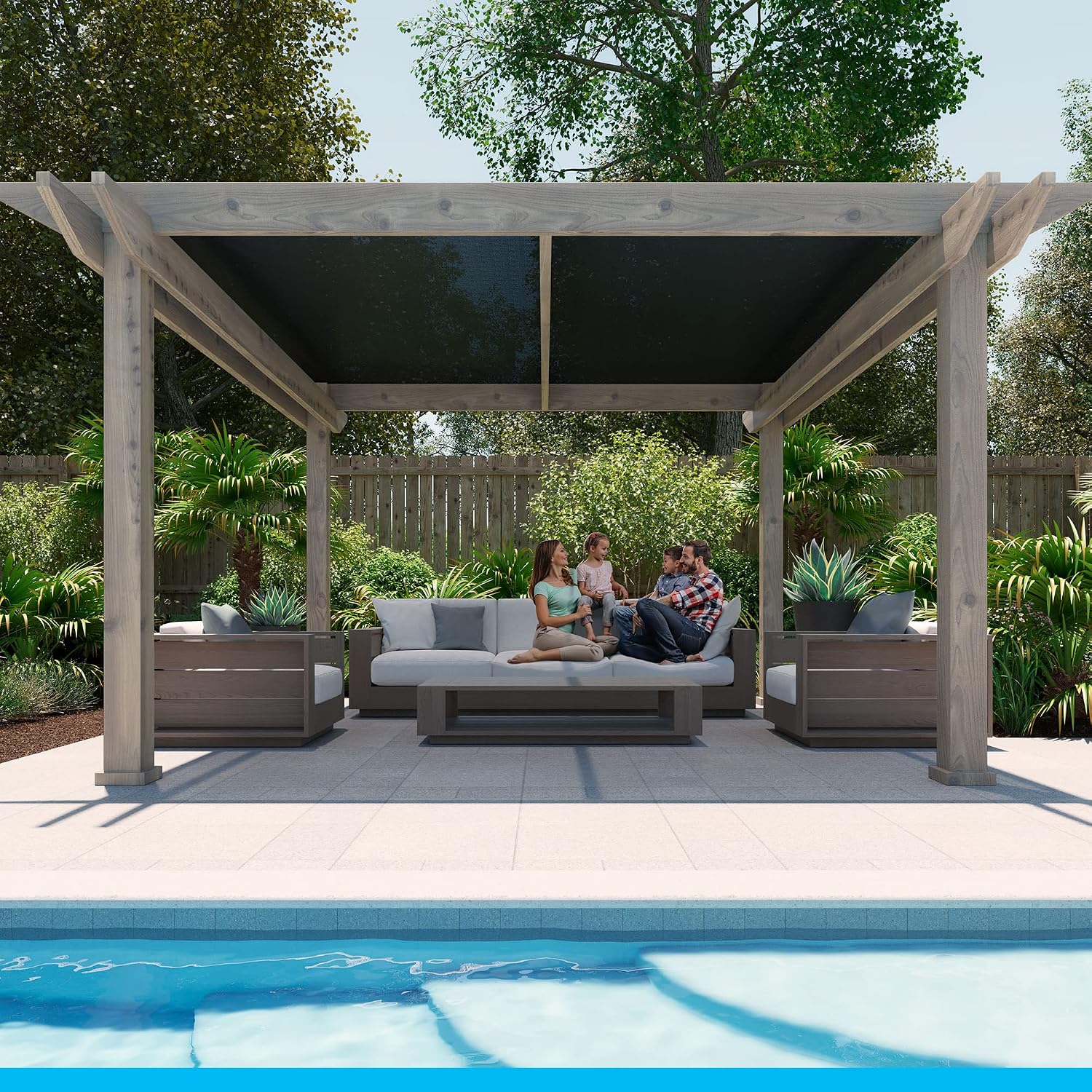
If you’ve ever searched “shade cloth” and landed in a wall of percentages — 30%, 60%, 70%, 80% — without any explanation of what those numbers actually mean, you’re not alone. The percentage is called the shade factor or shade rating, and it measures how much of the sun’s direct light the fabric blocks. A 70% shade cloth blocks 70% of incoming sunlight and lets 30% pass through. Simple concept, surprisingly easy to get wrong. Buy too low a rating for a sun-sensitive plant and you’ll scorch it; buy too high for a pergola living space and you’ll sit in a dim tunnel wondering where the afternoon went. This guide decodes the three most-purchased ratings — 60%, 70%, and 80% — so you can match the cloth to the job before the fabric ships, not after.
What the Percentage Actually Measures (and What It Doesn’t)
The shade rating is a light-reduction figure, not a heat-reduction figure. This distinction matters more than most product listings acknowledge. Shade cloth intercepts photons — it reduces the photosynthetically active radiation (PAR) that reaches plants and the raw solar intensity that hits your skin — but it does not insulate. A 70% shade cloth over a pergola will cut sun glare dramatically; it will not drop air temperature the way a fully enclosed screen room does.
A second common misunderstanding: the rating describes the cloth’s performance at the weave level, not the performance of your installed system. University of Florida IFAS Extension’s publication on shade cloth selection for greenhouses notes that installation gaps, roof pitch, and the angle of the sun at your latitude can all reduce effective shading by 5–15 percentage points compared to the labeled rating. A 70% cloth installed flat over a south-facing pergola in Tampa at noon in June will perform closer to 60% because of the low sun angle relative to the horizontal mesh. That same cloth installed on a vertical south-facing wall will perform closer to its rated value because it intercepts light more perpendicularly.
Practically, this means you should think of shade ratings as floor estimates, not ceilings, and bias slightly higher than your instinct when the structure is horizontal and your climate is extreme.
How the Fabric Is Rated
Reputable manufacturers rate shade cloth using standardized testing that measures transmitted light vs. incident light through the fabric panel itself. The weave density, yarn diameter, and knit pattern all contribute. Most shade cloth sold in the U.S. for horticultural and outdoor-living applications is made from high-density polyethylene (HDPE) monofilament — the same broad material category used in agricultural windbreaks. Clemson Cooperative Extension’s shading greenhouse guide notes that knitted HDPE cloth is preferred over woven cloth for pergola and greenhouse use because it resists fraying at cut edges, a meaningful practical advantage when you’re trimming custom sizes.
60% Shade Cloth: The Sweet Spot for Outdoor Living Spaces
For pergolas, patios, and outdoor rooms where the goal is human comfort rather than plant protection, 60% is the most popular starting point — and for most climates north of the Sunbelt, it’s sufficient.
Who it fits:
- Pergola seating areas where you want filtered sun, not full shade
- Warm-season vegetable gardens (tomatoes, peppers, squash) that need sun protection only during peak afternoon heat (roughly 1–5 p.m.)
- Pool surrounds in moderate climates where some UV reach is acceptable and you want to retain the feel of an open-air space
Who it doesn’t fit:
- Greenhouse growers in Florida, Texas, or Arizona managing heat-sensitive crops from May through September
- Orchid or fern growers who need consistent low-light environments
- Anyone in a zone where afternoon WBGT (wet-bulb globe temperature — a measure of heat stress that accounts for humidity and sun) regularly exceeds 88°F
Bob Vila’s overview of the best shade cloth options notes that 60% cloth is most frequently recommended for residential pergola applications because it strikes a balance between UV protection and retained natural light, allowing enough brightness to feel outdoors while reducing sunburn risk for people spending extended time in the space.
The tradeoff in plain terms: At 60%, your pergola will still feel sun-drenched. On a cloudless July afternoon in Atlanta, the space will be noticeably brighter than a covered porch. That’s a feature for some buyers, a bug for others. If you host afternoon gatherings and your guests are primarily seated, 60% will keep most people comfortable without making the space feel dark. If the space doubles as an outdoor workspace with monitors or screens, glare will still be an issue.
70% Shade Cloth: The Greenhouse Workhorse
If 60% is the residential comfort standard, 70% is the horticultural default. It covers the widest range of plants in the widest range of climates, which is why it dominates commercial greenhouse supply catalogs.
Who it fits:
- Cool-season vegetable crops (lettuce, spinach, arugula, kale) that bolt in direct sun
- Seedling flats during hardening-off — the transition period when indoor-started plants are acclimated to outdoor conditions
- Pergola dining rooms in Sunbelt climates (Florida, Texas, Gulf Coast) where 60% leaves guests uncomfortable from May through October
- Succulent and cactus nurseries during summer, when even drought-tolerant plants can sunburn under glass
University of Florida IFAS Extension’s shade cloth selection guide recommends 70% cloth as the baseline for Florida greenhouse production of most vegetable and annual flower crops, noting that the state’s combination of high solar intensity and high humidity makes 60% insufficient for protecting sensitive foliage during summer.
The tradeoff: At 70%, a pergola starts to feel shaded rather than sun-filtered. This is the right choice for most outdoor rooms in the deep South, but it can feel dark and slightly oppressive in northern latitudes (roughly Zone 6 and colder) where summer sun is already less intense and you may actually want maximum light in the space. Family Handyman’s shade sail and shade cloth installation guide observes that homeowners in northern states who install 70% cloth often remove it by late August because the space becomes too dim during the lower-angle late-summer sun.
By the Numbers: Quick Reference
| Shade Rating | Light Blocked | Light Transmitted | Primary Use Case |
|---|---|---|---|
| 60% | 60% | 40% | Pergolas (north of Zone 8), warm-season vegetables |
| 70% | 70% | 30% | Pergolas (Zone 8–10), greenhouses, seedling hardening |
| 80% | 80% | 20% | Orchids, ferns, deep-shade crops, privacy screens |
80% Shade Cloth: Specialty Applications and Common Mistakes
Eighty percent cloth is the most frequently over-specified option in the residential market. It solves real problems — but only for a narrow set of applications.
Legitimate use cases:
- Orchid and bromeliad production, where plants evolved under forest canopy and require consistent low-light conditions
- Shade houses for propagating cuttings, where rooting success drops sharply with direct sun exposure
- Livestock shade structures and agricultural work areas where human heat stress rather than plant biology is the driver
- Privacy screens on pergola side panels, where the shading effect is secondary to visual opacity
Where buyers go wrong: The most common mis-specification encountered in homeowner forums and contractor conversations is selecting 80% cloth for a food garden or a pergola based on the logic that “more shade means cooler, so 80% must be better.” For most vegetables, 80% cloth produces etiolated plants — stretched, pale, weak-stemmed growth caused by insufficient light — that yield poorly and are vulnerable to disease. Clemson Cooperative Extension’s greenhouse shading guide explicitly cautions against over-shading annual vegetable crops, noting that even shade-tolerant crops like lettuce require a minimum light threshold to photosynthesize efficiently.
For pergola living spaces, 80% creates a noticeably dim environment. This Old House’s pergola selection guide notes that the outdoor-room aesthetic most homeowners describe — bright, airy, filtered light — is compromised at 80%, with the space feeling more like a covered porch than an open pergola. That may be exactly what a buyer wants for afternoon privacy or glare control on a west-facing structure; it’s the wrong call if the goal is a light, open entertaining space.
When 80% is the right answer:
- West-facing pergolas in desert climates (Phoenix, Las Vegas, Palm Springs) where afternoon solar intensity is extreme and thermal comfort is the primary concern
- Side-panel privacy walls on any pergola, where opacity matters more than light
- Dedicated shade structures for outdoor workers or events where people stand rather than sit
Installation Variables That Change the Math
The shade rating on the label assumes the cloth is installed in a way that captures incoming light efficiently. Several real-world variables affect your effective shade level:
Roof pitch matters. A shade cloth installed at a 10-degree pitch over a flat pergola performs closer to its labeled rating than the same cloth installed flat. If your pergola roof is truly horizontal, consider the effective shade factor to be roughly 5–10 percentage points below the label in peak summer conditions, per IFAS Extension’s methodology notes.
Color affects perceived shade and heat absorption. Black shade cloth absorbs more heat but transmits light more neutrally. Aluminum-laminated and white shade cloth reflects more solar radiation and can reduce radiant heat under the structure. Owners in hot climates consistently report that aluminum or white cloth makes a perceptible difference in perceived temperature comfort, even at the same shade rating as black cloth.
Tension and sag. Sagging cloth creates pockets that concentrate water, accelerate UV degradation, and reduce effective shading uniformity. Family Handyman’s installation guide recommends a minimum 3% cross-slope for drainage and using grommeted edges with bungee attachment rather than rigid fastening to allow thermal expansion without tearing.
Layering. Some greenhouse growers layer two lower-rated cloths to approximate a higher rating during peak summer, then remove one layer in fall. A 50% and a 60% cloth layered together will not add to 110% — the math is multiplicative, not additive. Two 50% cloths transmit 0.5 × 0.5 = 25% of light, effectively creating a 75% shade condition. This approach gives seasonal flexibility without purchasing a higher-rated permanent installation.
The Decision Rule
If you’re sitting with a specific project and a purchase decision pending, here’s the clean framework:
If your structure is a pergola or outdoor room:
- Zone 7 and colder, or north-facing/east-facing exposure → 60%
- Zone 8–10, south/west-facing, or Sunbelt summer use → 70%
- West-facing desert climate, privacy panel, or extreme heat context → 80%
If your structure is a greenhouse or high tunnel:
- Warm-season vegetables (tomatoes, peppers, squash) → 60%
- Cool-season vegetables, seedling hardening, most annual flowers → 70%
- Orchids, ferns, shade-house propagation → 80%
If you’re genuinely unsure between two adjacent ratings — say, 60% vs. 70% for a Zone 8 pergola — bias toward the higher number. The cost difference between ratings is typically under $0.15 per square foot at current 2026 HDPE cloth pricing, and the discomfort of an under-shaded space is harder to fix post-installation than a space that reads slightly darker than expected. You can always reposition furniture toward the edges to catch more sun; you cannot reposition the sun.
The shade percentage on the label is a starting point, not a guarantee. Use it alongside your climate zone, the structure’s orientation, and what you’re actually putting under the cloth — and the right number becomes straightforward.