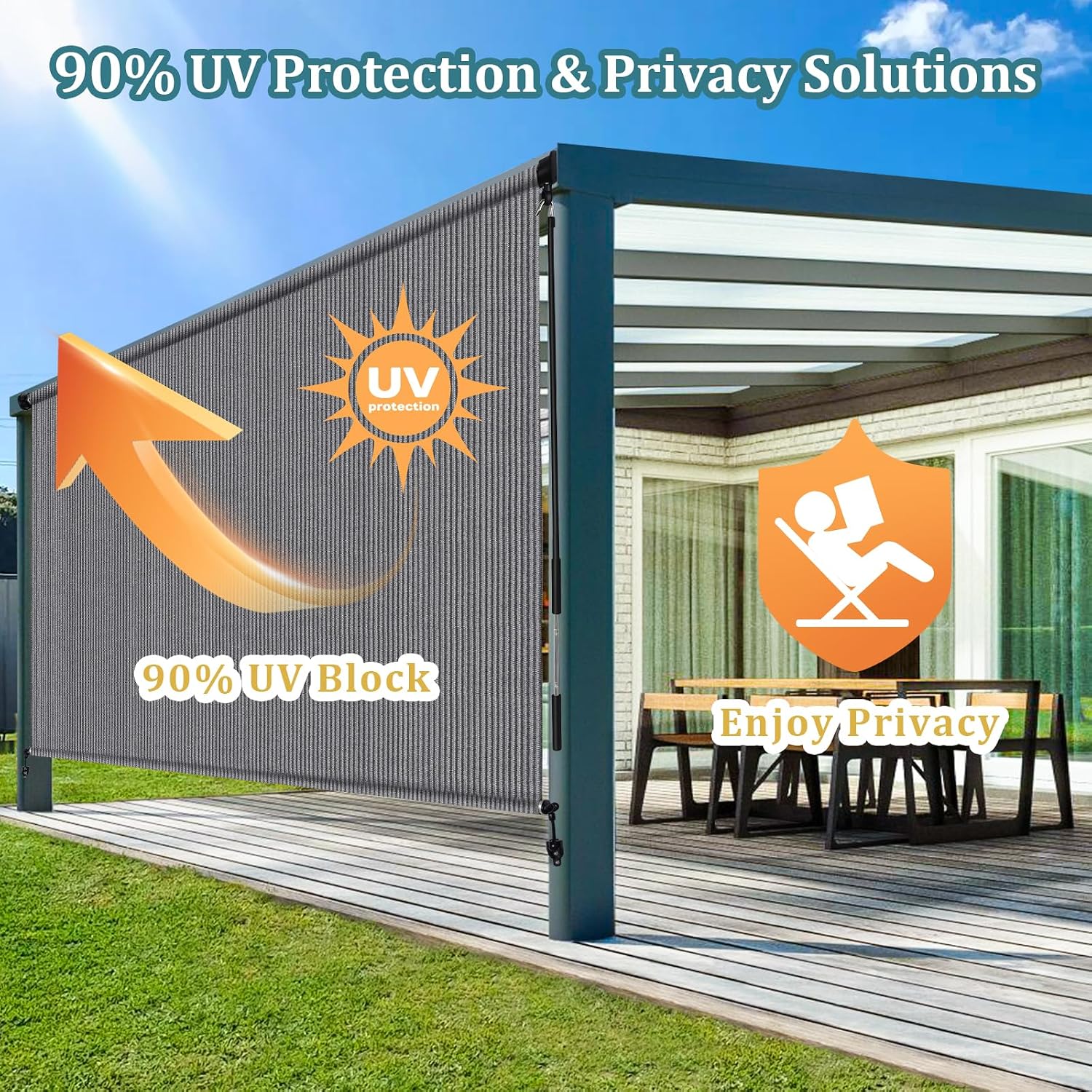
If you’ve been shopping outdoor roller shades for a porch or pergola, you’ve already noticed the jargon wall: “openness factor,” “solar transmittance,” “spliced-pole aluminum tube.” Before any of that matters, here’s the plain-language version of what these products actually are. Outdoor roller shades are fabric panels mounted to a horizontal tube (the roller) above a window, door, or open-air beam; you pull or motor them down to block sun, wind, and insects — or roll them back up when you want the open-sky feel. The fabric itself is the whole game: its density determines how much light, heat, and UV radiation passes through, and those numbers are measured, tested, and published by fabric manufacturers, so you can compare products objectively. This article walks through how to read those numbers, explains why the pole’s construction matters as much as the fabric on wider spans, and gives you the decision framework to match a shade spec to your actual porch situation — whether you’re sourcing a single manual shade for a side pergola or speccing six motorized drops for a screened lanai addition.
Openness Factor: The Number Every Spec Sheet Shows (and What It Actually Means)
The openness factor (sometimes called percent open area) is the single most important fabric metric on an outdoor roller-shade spec sheet. It represents the percentage of a fabric’s surface area that is literally open — gaps between fibers where light and air pass through unobstructed. A 1% openness fabric is nearly opaque; a 14% openness fabric is close to sheer screening. Most residential porch shades fall in the 3%–10% range, and where you land in that range is a real tradeoff.
Lower openness (1–3%) delivers maximum glare block, the best solar heat rejection, and the most privacy from outside views during daytime. The tradeoff: your outward view is compressed — manufacturers describe this as looking through a fine mesh, similar to a window screen pulled tight. Phifer Incorporated’s SunTex Solar Screen technical data sheet rates their 1% openness fabric at approximately 99% UV block, meaning almost no ultraviolet radiation reaches furniture or skin on the shade side.
Mid-range openness (5–10%) is where most porch and pergola installations land. You get meaningful glare reduction and a comfortable view to the yard, but some direct sun will still reach a dining table at peak afternoon angles. Phifer’s 5% SunTex fabric is spec’d at roughly 95% UV block — still more than adequate to protect outdoor furnishings and prevent significant fading over a season.
Higher openness (10–14%) is primarily a light-diffusion play. Think of it as taking the harsh edge off afternoon sun while preserving an almost-unobstructed sightline. Heat rejection drops, and UV block numbers fall to the 85–88% range on most published spec sheets — still far better than no shade at all, but a meaningful step down.
By the Numbers: Typical Fabric Openness vs. UV Block
| Openness Factor | Approx. UV Block | Best Use Case |
|---|---|---|
| 1% | ~99% | West-facing exposure, intense Sunbelt glare |
| 3% | ~97% | Privacy + glare reduction, most porch orientations |
| 5% | ~95% | Balanced view + shade — most popular spec |
| 10% | ~88% | Light diffusion, shaded north-facing pergola |
| 14% | ~83% | Decorative diffusion only — limited solar rejection |
Source: Phifer Incorporated SunTex Solar Screen Fabric Technical Data Sheet; figures are manufacturer-published for woven PVC-coated polyester solar fabric.
One thing spec sheets sometimes conflate: UV block is not the same as solar heat gain rejection (SHGR). UV block tells you how much ultraviolet radiation — the component that fades cushions and damages skin — is stopped by the fabric. Solar heat gain rejection measures how much of the total solar energy spectrum (visible light plus infrared) is rejected. Lawrence Berkeley National Laboratory’s Windows and Daylighting Group has documented that infrared radiation accounts for roughly 53% of total solar heat load at ground level, which means a fabric that blocks 99% of UV but has a mediocre solar transmittance value is still letting significant heat through. Ask your supplier for total solar transmittance numbers, not just UV block, especially if thermal comfort — not just fade protection — is the goal.
Why Pole Construction Changes Everything Beyond Eight Feet
Here’s a spec most homeowners skip until a shade fails: the roller tube. For spans under 72 inches (six feet), a standard single-piece 1.5-inch or 2-inch extruded aluminum tube handles the load without drama. Extend that to 96 inches, 120 inches, or the increasingly common 144-inch (twelve-foot) span on pergolas, and tube deflection — the tube bowing under the weight of fabric — becomes the primary failure mode.
Deflection is the downward sag a horizontal tube develops under load. A standard 1.5-inch aluminum extrusion on a 120-inch span with a heavy solar-screen fabric can deflect visibly at midspan — owners of budget-tier shades at that width consistently report the roller binding or failing to roll evenly after one or two seasons. The physics are straightforward: deflection scales with span cubed, which means doubling the width multiplies the deflection problem by a factor of eight.
The Spliced-Pole (or Double-Tube) Solution
Quality outdoor shade manufacturers address this with either:
-
A larger-diameter single tube — typically 2.5-inch or 3-inch extruded aluminum — which has dramatically higher section modulus (resistance to bending) at the cost of added weight and a bulkier head-rail profile.
-
A spliced-pole design, where a smaller inner steel or aluminum tube is inserted and mechanically bonded inside the outer aluminum extrusion, creating a composite section with meaningfully higher stiffness at modest weight cost.
Published specs from manufacturers like Coolaroo and Insolroll describe their wide-span systems using reinforced or double-wall tubes for widths beyond 96 inches precisely because of this deflection problem. When you’re evaluating a shade quote above eight feet wide, ask the supplier to specify the tube outer diameter, wall thickness, and whether any inner reinforcement is used. A single number to check: the tube’s wall thickness. Budget shades at 120-inch spans often spec 1.0–1.2mm wall aluminum; quality commercial-grade tubes spec 1.5–2.0mm wall, which roughly doubles section stiffness before any reinforcement is added.
For motorized systems, deflection matters doubly: a sagging tube causes uneven fabric tension, which causes the motor to overdraw current on one side — a leading cause of motor burnout on wide motorized shades. This Old House’s outdoor shade buying guide specifically flags tube rigidity as the first spec to verify before motorizing any shade wider than 96 inches, a recommendation consistent with what specialty shade contractors consistently note in the trade.
UV Ratings in Context: What the Certification Numbers Mean for Your Climate
The UV block number on a fabric spec sheet is almost always derived from ASTM G173 testing protocols — a standardized reference solar spectrum developed by ASTM International that represents solar irradiance at mid-latitude ground level. This is the benchmark against which fabric manufacturers measure solar transmittance, so it’s apples-to-apples across brands when both use it. The number to look for on a spec sheet is Ultraviolet Transmittance (UVT): a UVT of 1% means 1% of UV radiation passes through — so a fabric spec’d at “99% UV block” has a UVT of 1%.
Why does climate matter? In Sunbelt regions — Florida, Texas, Arizona, and Southern California — peak UV index regularly exceeds 10 on the WHO’s scale during summer afternoon hours, per publicly available NOAA UV index data. At those levels, even a fabric with 90% UV block still allows an effective UV index of 1.0 at surface level — low, but not zero. For clients installing shades over a lounge area where occupants sit for hours, or where protecting high-value teak or wicker furniture from fading is the stated goal, specifying 3% or tighter openness fabric is not over-engineering — it’s the minimum responsible spec.
In a milder Pacific Northwest or upper Midwest climate, the same furniture under a 5–10% openness shade may last just as long because peak UV exposure hours are fewer and UV index peaks are lower. Angi’s 2025 national cost report on outdoor shade installation notes that Sunbelt markets — particularly Florida’s Gulf Coast and the Dallas–Houston corridor — show a measurably higher proportion of dense-fabric (3% and below) purchases compared to national averages, consistent with installer and dealer feedback about what holds up in that UV environment.
The Decision Framework: If X, Then Y
By now you have the three variables that actually drive spec selection: openness factor, tube construction, and climate-adjusted UV context. Here’s how to use them.
If your porch or pergola faces west or southwest and you’re in a Sunbelt market (Florida, Texas, Arizona): Specify 1–3% openness fabric. The glare reduction and thermal comfort gain are immediate and owner-reported reviews at this opening factor are consistently positive for west-exposure applications. Tube diameter matters less here if your span is under 96 inches; spend the money on fabric density instead.
If your span exceeds 96 inches and you’re planning motorization: Tube construction is your first specification decision, not fabric. Confirm minimum 2-inch outer diameter with 1.5mm wall thickness or internal reinforcement before you commit to a motor system. Paying $200–$400 extra for a commercial-grade tube on a 120-inch motorized shade is far cheaper than a motor replacement in year two.
If your priority is view preservation with light diffusion — covered patio, north-facing pergola, shaded courtyard: 5–10% openness fabric is the right range. UV block is still meaningful at 88–95% in this bracket. You will not get significant heat gain rejection at 10% openness; set that expectation with your client or household before purchase.
If you’re mid-spec and unsure between 3% and 5%: Default to 3% on south and west exposures; default to 5% on east exposures. The 2% openness difference is invisible to the eye in most installation contexts — owners report no meaningful view difference between 3% and 5% in aggregated reviews — but the UV and glare performance difference at west exposures is real and measurable on a fabric spec sheet.
If budget is the binding constraint: A single-piece 2-inch tube standard shade from a name-brand fabric supplier (Phifer, Mermet, Serge Ferrari all publish ASTM G173-based spec sheets) outperforms a wide-span budget shade with a flimsy tube at nearly every price point. Material quality in the fabric and the tube extrusion is where the value gap lives; the mounting hardware matters much less than either.
Outdoor roller shades are a straightforward category once you know which three numbers to read. The UV block figure is only as useful as the test standard behind it; the openness factor is the one that controls both privacy and view; and the tube spec is the one most likely to be underspecified on wider drops. Get those three right, and the rest of the installation — hardware, mounting method, manual vs. motorized drive — follows logically from your porch geometry and budget.