A garage screen door is exactly what it sounds like — a screen panel (or pair of panels) that fits across your open garage doorway, letting air and light in while keeping insects, debris, and some wind out. For a single-car opening that’s typically 8–9 feet wide, the market is straightforward. For a two-car opening — usually 16 feet wide — the choices split sharply between two fundamentally different approaches: magnetic mesh, where two large fabric panels hang from a top track and meet in the middle with magnets, and sliding track systems, where rigid-framed screen panels roll or slide on mounted aluminum tracks. Both can work well. Both can fail badly if you pick the wrong one for your situation. If you have a deal in motion — a contractor quote sitting on your desk, a holiday weekend project planned, or a client asking for a spec recommendation — this guide is written for you. We’ll name the tradeoffs, show the math, and give you a clear “if X, then Y” at the end.
| EDITOR'S PICK[Sliding Garage Door Screen with…](https://www.amazon.com/dp/B0GLPYG5DD?tag=greenflower20-20) | Mid-tier[FEGO Garage Door Screen 16x7FT](https://www.amazon.com/dp/B08TSZ4WC7?tag=greenflower20-20) | Budget pick[Elytsemoh Garage Screen Doors f…](https://www.amazon.com/dp/B0BVBBR1JY?tag=greenflower20-20) | |
|---|---|---|---|
| Closure type | Track/Sliding | Magnetic | Magnetic |
| Weighted bottom | — | ✓ | — |
| Magnets | — | 40 | — |
| Roll-up straps | — | — | 6 |
| Hands-free | — | ✓ | ✓ |
| Price | $99.99 | $39.97 | $28.99 |
| See on Amazon → | See on Amazon → | See on Amazon → |
The Core Difference: How Each System Actually Works
Before comparing price and durability, it’s worth being precise about the mechanical reality of each type, because that reality drives every downstream tradeoff.
Magnetic mesh panels are essentially two large rectangles of fiberglass or polyester mesh, hemmed with weighted edges and magnets sewn into the center seam. They hang from a header track mounted at the top of the opening. You walk through the middle, the panels fall back together, and the magnets re-seal. Setup is typically under an hour — you’re installing a header rod or tension cable and hanging fabric. The total hardware load on your garage frame is minimal. According to This Old House’s “Garage Screen Door Review and Buying Guide,” magnetic mesh is the dominant format for DIY buyers in the $30–$150 range, and most products in this tier are sized to cover standard 16-foot two-car openings out of the box.
Sliding track systems (sometimes called roll-up or retractable garage screen systems) use aluminum-framed panels — think of oversized screen door frames — that slide horizontally along a floor track and an overhead track. On two-car openings, the most common configuration is a bi-parting setup: two panels that meet in the middle, each sliding to one side when you want to drive in or out. Higher-end versions use a spring-tensioned retractable mechanism; mid-range versions simply slide manually and latch. According to Angi’s “How Much Does a Garage Screen Door Cost?” (2025–2026 pricing data), professionally installed sliding track systems for a standard two-car opening run $400–$1,800 installed, depending on frame material, screen mesh grade, and whether the system is manually operated or motorized.
The gap between those two price ranges — $30 to $1,800 — isn’t arbitrary. It maps almost exactly to the gap in durability, wind resistance, and walkthrough convenience.
Price-Point Breakdown: What You Get at Each Tier
Entry-Level Magnetic Mesh: $30–$100
This is the impulse-buy tier. Products in this category are sized for 16-foot openings and install with thumbtacks or adhesive hook-and-loop tape on the header. As documented in Bob Vila’s “The Best Garage Screen Doors” roundup, owners consistently report that entry magnetic mesh works well for casual summer use — keeping mosquitoes out while you work on a weekend project. The recurring complaint across aggregated reviews is wind: once gusts exceed about 10–12 mph, the panels billow, the center seam separates, and the magnets lose their grip. For a detached garage facing a prevailing wind, this is a meaningful limitation.
Expected lifespan: 1–3 seasons. Best for: Occasional weekend use, renters, anyone prioritizing reversibility over durability.
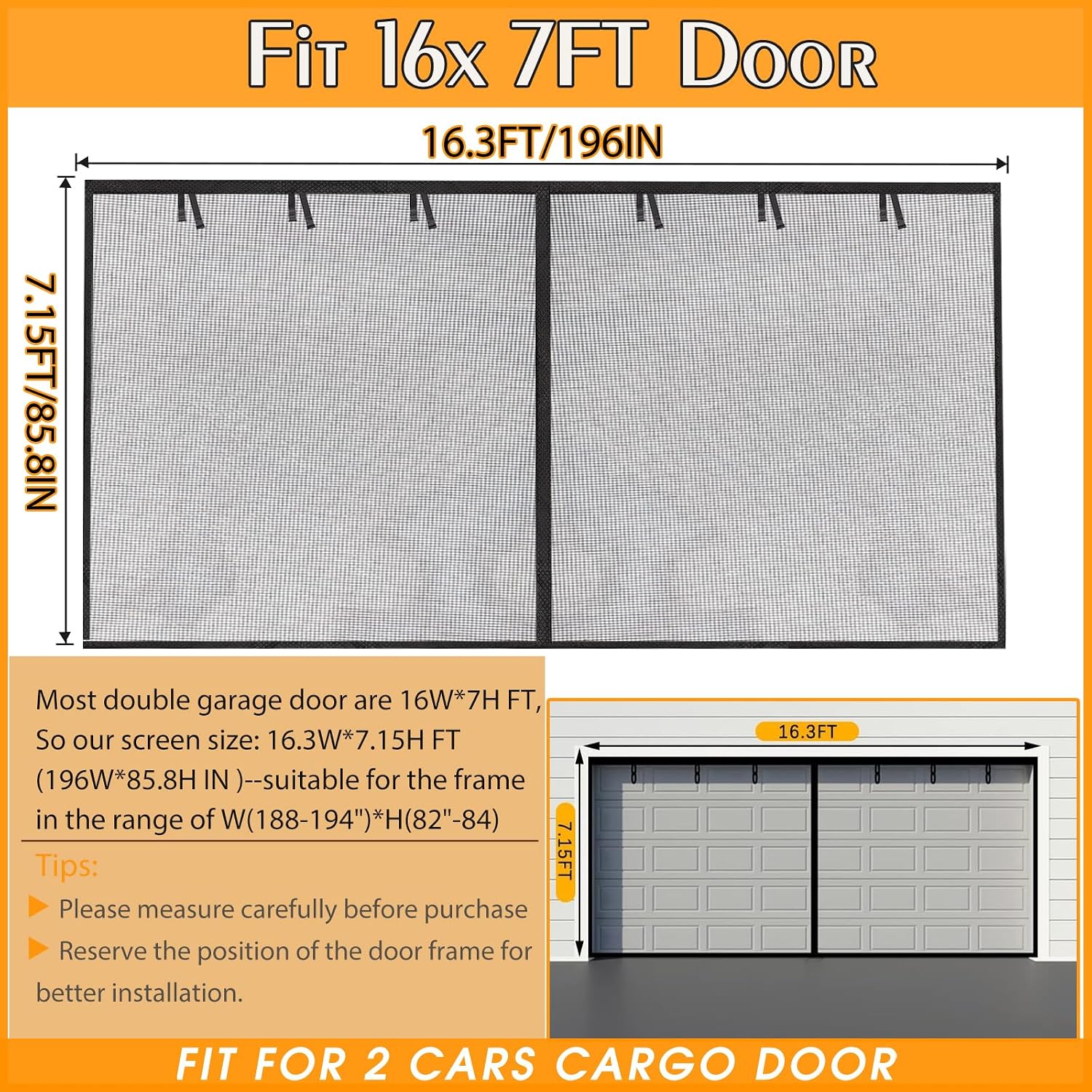
Elytsemoh
$28.99
In stock on Amazon
Check price on AmazonReinforced Magnetic Mesh: $100–$250
This tier adds weighted bottom hems, stronger rare-earth magnets at the center seam, and denser mesh fabric — typically 115–140 gsm polyester versus 80–90 gsm at entry level. Family Handyman’s “Garage Door Screen Options” notes that reinforced products in this range hold up noticeably better in light-to-moderate wind and resist UV degradation longer than entry-level fabric. You’re still looking at a fabric panel on a tension rod, though — the fundamental wind and walkthrough limitations don’t disappear, they just move the threshold higher.
Expected lifespan: 3–5 seasons. Best for: Homeowners who want meaningful bug protection at modest cost and don’t face regular high winds.

FEGO
$39.97
In stock on Amazon
Check price on AmazonManual Sliding Track Systems: $250–$600 DIY / $400–$900 Installed
This is where the product category changes character. You’re now dealing with aluminum extrusion tracks, fiberglass or aluminum-framed screen panels, and a floor track that requires either adhesive mounting or light drilling. The frame holds the screen taut regardless of wind, the panels slide smoothly, and — critically — you can drive through without touching the screen at all: panels push to the sides, leaving the full 16-foot opening clear. Spec sheets for products in this range typically rate them for winds up to 25–30 mph when properly latched.
The tradeoff is installation complexity. This Old House’s “Garage Screen Door Review and Buying Guide” flags that two-car sliding systems require precise measurement and are best approached as a half-day project minimum, not a 45-minute hang. Floor tracks require a level slab, and the header must be anchored securely enough to handle panel weight.
Expected lifespan: 7–12 years. Best for: Active vehicle bays, workshop garages, climates with regular afternoon gusts.
FEGO
$39.97
In stock on Amazon
Check price on AmazonMotorized Retractable Systems: $800–$2,000+ DIY / $1,200–$2,500+ Installed
At this tier you’re in the same product family as whole-patio motorized screen enclosures. Systems at this level use a cassette-housed spring motor or 12V DC electric motor mounted in the header. The screen rolls up completely out of sight when not in use, eliminating the floor track entirely — a meaningful benefit for garages used as workshops or gyms where floor clearance matters. Motorized systems in this range typically integrate with standard 120V wiring and, depending on the brand, may offer smart-home protocol compatibility.
Warranty terms at this tier are substantially more robust than lower tiers. According to Angi’s “How Much Does a Garage Screen Door Cost?”, contractors report that homeowners who opt for a manual sliding system initially tend to upgrade to motorized within three to five years; buying the upper tier first has favorable math if the space is used daily.
Expected lifespan: 10–15+ years. Best for: Garage-to-living-space conversions, entertainment or gym setups, whole-home automation integration.
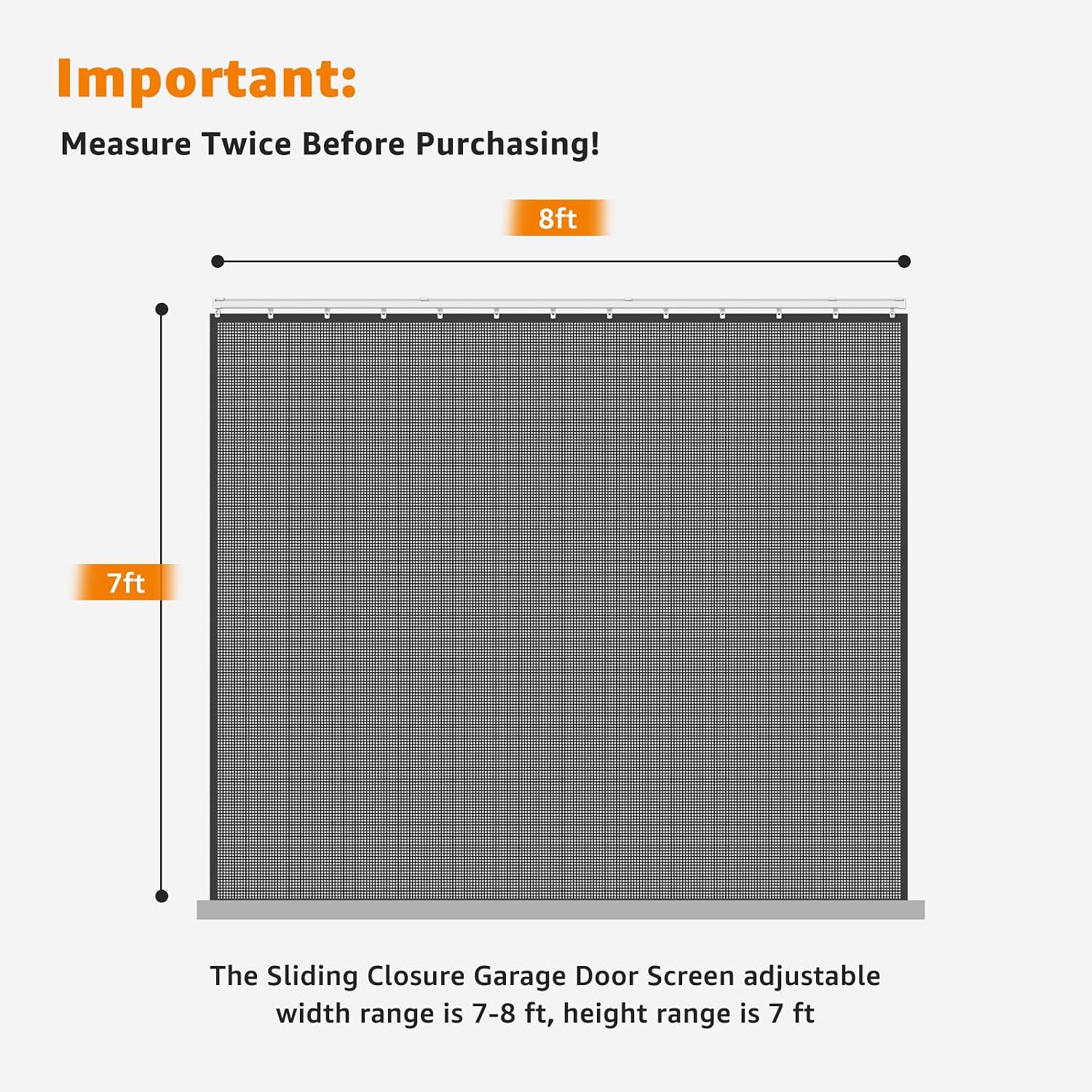
Sliding
$99.99
In stock on Amazon
Check price on AmazonComparison at a Glance
| Tier | System Type | DIY Price | Installed Price | Lifespan | Wind Resistance | Drive-Through Ready |
|---|---|---|---|---|---|---|
| Entry | Magnetic mesh | $30–$100 | DIY only | 1–3 seasons | Low (10–12 mph) | No — panels must be tied back |
| Mid | Reinforced magnetic mesh | $100–$250 | $150–$350 | 3–5 seasons | Moderate | No — panels must be tied back |
| Mid-upper | Sliding track, manual | $250–$600 | $400–$900 | 7–12 years | High (25–30 mph) | Yes — bi-parting panels |
| Premium | Sliding track, motorized | $800–$2,000+ | $1,200–$2,500+ | 10–15+ years | High | Yes — full retraction |
Price ranges based on Angi cost data and aggregated product listings as of May 2026.
The Tradeoffs That Actually Matter for a 16-Foot Opening
A 16-foot span creates stresses that simply don’t exist at 8 or 9 feet. Here’s where each system either rises or falls.
Wind load. This is the dominant failure mode for magnetic mesh on wide openings. The center seam of a 16-foot magnetic panel is under twice the lateral stress of an 8-foot version in the same wind conditions. Owners consistently describe panels separating, fabric billowing into the garage, and magnets pulling free in anything beyond a light breeze. If your garage faces prevailing winds, sits in a coastal or Gulf-region market where afternoon gusts are routine, or falls under a jurisdiction with meaningful wind-load provisions in its building code, magnetic mesh is a seasonal-use compromise — not a solution. Sliding track and motorized retractable systems handle wind categorically better because the frame transfers load to the track anchors rather than relying on the mesh to hold tension.
Drive-through clearance. With magnetic mesh, both humans and vehicles interact with the fabric. You push through to walk in, and you’d need to manually tie back both panels to drive in. This works fine for pedestrian use; it’s a nuisance for regular vehicle access. Sliding track bi-parting systems solve this cleanly: panels push to each side wall and latch, leaving the full opening clear. For a garage that’s a working shop or active vehicle bay, this convenience difference compounds over dozens of uses per week.
Installation commitment and reversibility. Magnetic mesh is the most reversible option — remove the header rod, roll up the fabric, done. This matters if you’re renting, if HOA rules are ambiguous, or if you want to evaluate the concept before committing to a permanent installation. Sliding track systems require drilling into the slab and header, which is a real commitment. Motorized systems require an electrician if you want hardwired power, though some battery-operated options exist. The hierarchy is clear: magnetic mesh → manual sliding → motorized, in ascending order of installation effort and reversibility cost.
Cost-per-season math. A $60 magnetic mesh screen replaced every two seasons costs $30 per year. A $600 installed manual sliding system at a seven-year minimum lifespan costs roughly $85 per year. A $1,800 motorized system at twelve years costs $150 per year — but also adds a feature set (clean retraction, smart-home integration, zero floor track) with genuine value for a garage-as-living-space conversion. Family Handyman’s “Garage Door Screen Options” notes that the true cost comparison shifts substantially once replacement frequency and installation labor are factored in.
Decision Rules: If X, Then Y
If you’re settling a pending decision, use this framework:
If you use the garage primarily for weekend projects and want basic bug protection → Entry or reinforced magnetic mesh. Spend $60–$150, accept that it’s a seasonal tool, and move on.
If you’re in a coastal, Florida, Texas, or Gulf-region climate with regular afternoon wind → Magnetic mesh in any form will frustrate you. Start at the manual sliding tier ($400–$900 installed). The wind-load difference is not marginal.
If the garage is being converted into a year-round living, gym, or entertainment space → Motorized retractable is the correct tier. The clean retraction and integration capability are genuine functional upgrades, and the cost-per-year math becomes favorable at regular daily use.
If you’re a contractor spec’ing for a client → Manual sliding for clients who prioritize budget clarity; motorized for clients who ask about smart-home integration or who are already spending on a whole-home automation system. Both This Old House’s “Garage Screen Door Review and Buying Guide” and Angi’s cost guide flag that professional installation on sliding-track systems dramatically reduces the callback rate versus homeowner DIY — factor that into your labor quote.
If reversibility or rental-property use is the constraint → Magnetic mesh only. It’s the only tier that leaves the structure completely unchanged.
The two-car garage opening is wide enough that the wrong choice is expensive in either direction — paying too little for a mesh screen that fails in the first windstorm, or over-specifying a motorized system for a garage that sees two cars and a lawnmower twice a week. Match the system tier to the actual use pattern and climate, and the decision becomes straightforward.